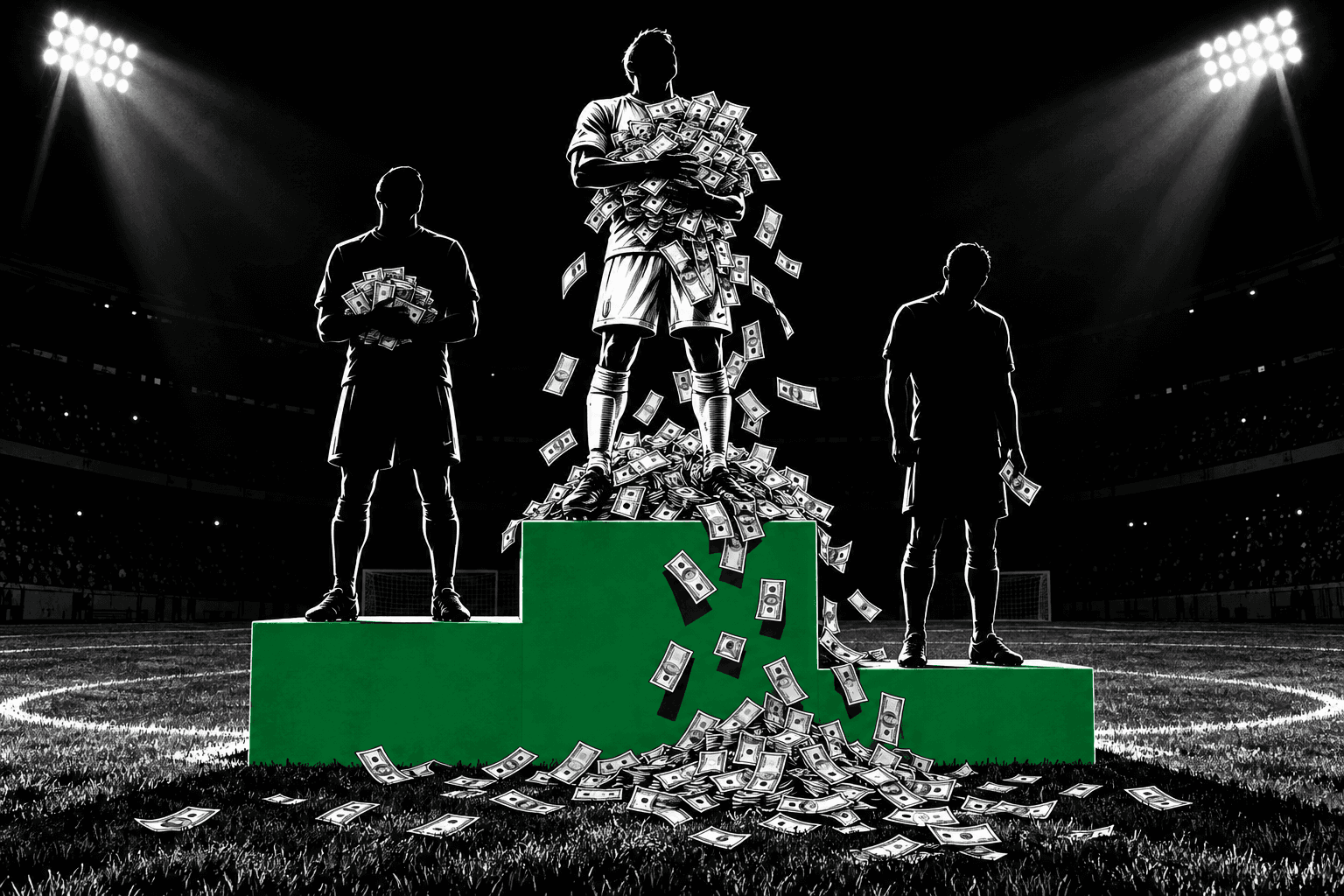

Harry Kane has just been chosen the best footballer in the world and yet he is the cheapest of the three who stepped onto the Ballon d'Or podium. According to Transfermarkt, the Bayern striker is worth around 60 million euros. Kylian Mbappé, second place, stands at 200 million. Lamine Yamal, third, at 220. The player the vote considers the best of the season is worth less than a third of the one who finished behind him.
It looks like a contradiction, but it is not. The Ballon d'Or and market value measure different things. The award looks backwards: it recognises what a player did in the season that just ended. Market value looks forwards: it estimates how much a club would pay for him today, and what a club pays is everything that player can give them over the coming years, including what they might earn by selling him on.
That is where two variables the award ignores entirely come into play: age and contract. Kane is 33 and his contract with Bayern runs until June 2027. Mbappé is 27 and tied to Real Madrid until 2029. Lamine Yamal is 19 and signed with Barça until 2031. A club that signed Kane today would be buying, at most, a couple of seasons at the highest level and no chance of recovering the money by selling him afterwards. With Yamal they would be buying a decade ahead.
Kane's own transfer illustrates the point. Bayern paid Tottenham around 100 million euros in 2023 for a 30-year-old striker with one year left on his contract. They knew they would never recoup that investment through a sale. They paid for the present, and the present has given them back titles and now a Ballon d'Or. But that bet has an expiry date, and the market discounts it with every passing season.
This year is no exception. Since 2018, the Ballon d'Or winner has only been the most valuable player on the podium on two occasions, both times with Messi. In the rest, the gap was enormous. Luka Modric won in 2018 at 33 with a value of 25 million, while Antoine Griezmann, third place, was worth 150. Messi won in 2023, already at Inter Miami, valued at 35 million, with Haaland and Mbappé on the podium at 180 each. Rodri won in 2024 at 130 million against Vinicius's 200, and Dembélé in 2025 at 100 against the 200 of a Lamine Yamal who even then finished second.
Nor does the award change things afterwards. Winning the Ballon d'Or does not push a player's market value up. Modric kept losing value in the months after receiving it, and the same happened to Benzema in 2022 and to Messi in his last two trophies. What the award does multiply is sponsorships and the player's image value, but that goes into his pocket, not into his transfer price tag.
So the question of whether there should be a correlation between the best player and the most expensive one has a simple answer: no, because football pays for what is coming, not for what has already happened. The Ballon d'Or is a trophy for last season. Market value is a bet on the ones ahead. And in that bet, a 19-year-old kid is worth more than the best player in the world at 33.