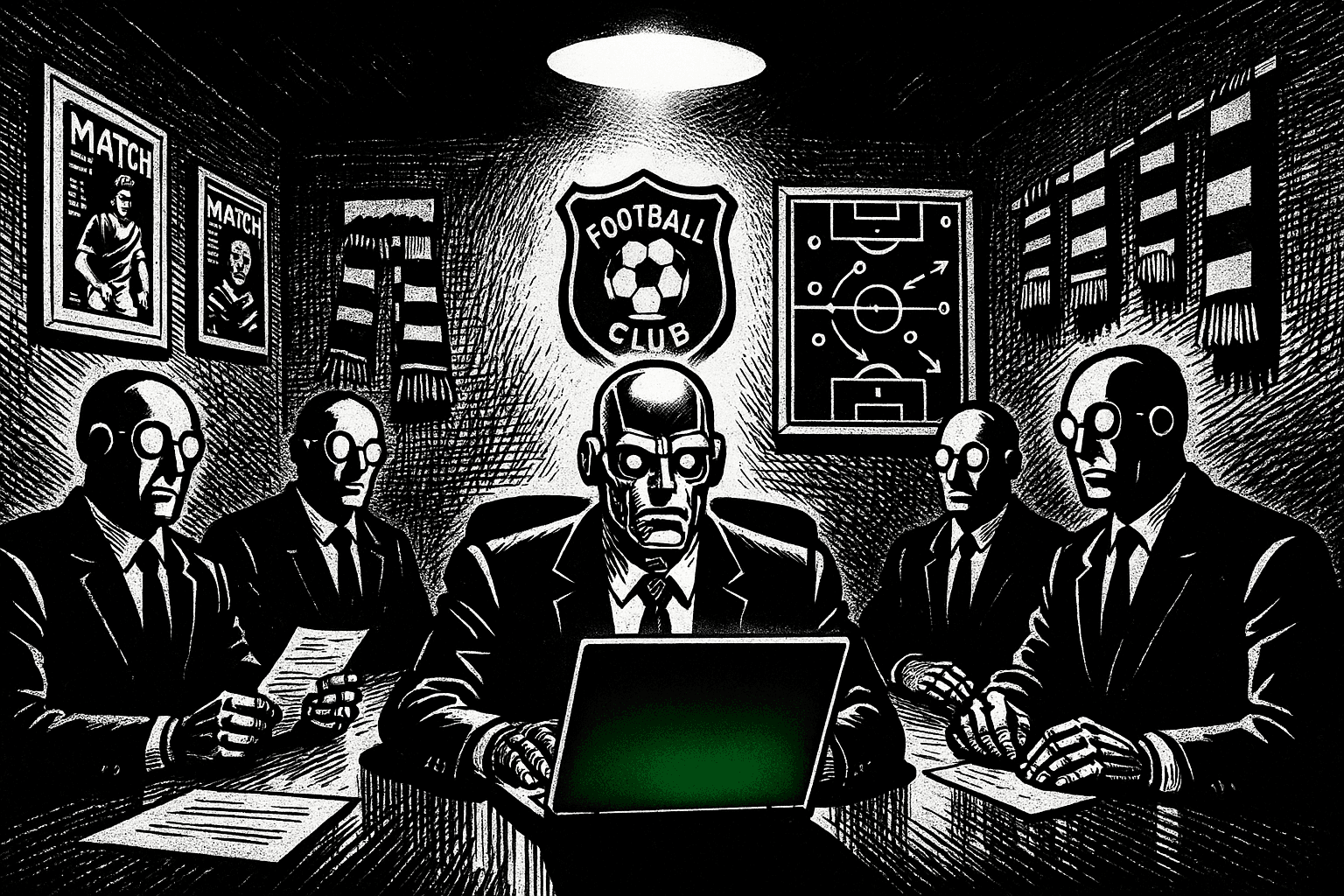

In June 2024, the twenty Premier League clubs sat down to vote on whether to kill VAR. Wolverhampton had put the motion in plain terms, fed up with endless waits and millimetric decisions arriving three minutes late. The result was 19 to 1. Nineteen clubs decided that removing video refereeing would be competitive suicide, a self-exclusion from the club of serious leagues. A single vote to abolish it. And there, in that absurd asymmetry, lies the business.
Because nobody votes to keep something they hate unless giving it up costs them more. VAR stopped being a tool of justice a long time ago. It is a B2B market with multimillion-dollar tenders, antitrust litigation, and a handful of multinationals carving up contracts that no organiser can negotiate on equal terms. Sporting fairness is the wrapper. Underneath sits a technology oligopoly that invoices by match, by season, and for every piece of data that slips through the stadium cameras.
The money does not go to referees or federations. It goes to Hawk-Eye, Mediapro, Genius Sports and company, who sell something far more profitable than line-drawing software. They sell dependency.
The barrier to entry was erected by FIFA itself through its Quality Programme and innovation approval protocol. To operate a certified VAR system, a provider must demonstrate multi-angle synchronisation, transmission latency, resolution, and the accuracy of virtual offside lines. In plain language, only a handful of companies on the planet can even enter a tender. Everyone else is eliminated before the starting whistle. It is the classic move of any regulated industry, where whoever sets the technical standard decides who plays and who watches from the stands.
Hawk-Eye, owned by Sony, is the name in every important photograph. FIFA World Cups, UEFA Champions League, Serie A, stretches of LaLiga and the Premier League. Its model is the multi-year turnkey contract per competition, plus broadcast licensing. They do not sell a licence; they sell the entire system with their own people inside it. Mediapro plays a different card, the convergent package, where VAR travels bundled with television signal production and outside broadcast units. That is how it secured LaLiga for the cycle beginning in 2024, CONMEBOL with the Libertadores and Sudamericana, and up to fourteen leagues spread across the world. Genius Sports, by contrast, enters through the sports-betting data door. Its semi-automated offside technology in the Premier League, Brazil, and Belgium is not the end goal; it is the pretext for signing long-term data agreements worth far more than the SAOT fee.
That is the finer mechanics of the business. The VAR contract is the door, not the room. Once you have thirty cameras and cabling embedded in a stadium, that infrastructure serves to sell player tracking, 3D reconstructions, real-time data, and everything an ecosystem of betting and content is willing to pay for. Refereeing finances the installation. The rest is margin.
The numbers reveal what all of this costs. In Spain, the inaugural 2018-19 season came to roughly 2.5 million euros per division, two million in technology and half a million in refereeing structure, all centralised in Las Rozas. With the Segunda division added and semi-automated offside introduced, LaLiga's annual bill moved, according to implementation data, between five and seven million euros. In England, the Premier League launched in 2019-20 with around 2.7 million pounds in direct operating costs and roughly 20,000 pounds per match shared among the clubs playing.
Italy treated it as a matter of state. Serie A inaugurated with Hawk-Eye a VOR centre in Lissone, near Milan, with twelve operational rooms capable of housing more than sixty technicians per matchday, forty full-time employees and more than one hundred and sixty independent professionals. That is no longer refereeing; it is an industrial plant. Scotland, more modestly, spent around two million pounds annually distributed among clubs according to table position, which is an elegant way of saying that the team bottom of the league also foots the bill.
That the market is serious spoils was demonstrated by the Spanish legal dispute better than any report. The RFEF stripped the VAR contract from Mediapro and handed it to Hawk-Eye, citing greater international experience. Mediapro challenged the decision, arguing its bid saved money and that the tender specifications had been written to fit the British company, and took the case to court. The matter ended with the contract split in two for the new cycle, VAR on one side and semi-automated offside on the other. They fight over this because this pays. Nobody litigates for years over a service that does not matter.
And it works, to be fair. Studies by IFAB itself across thousands of matches raised precision in decisive incidents above 98%. The Premier League improved its decision-accuracy rate clearly in its first season, with more than a hundred corrected calls, roughly one every few matches. The accuracy tribunals vindicate the technology. The problem is the other figure, the one pointing to what happens when the on-field referee walks to the screen. He reverses his decision almost every time and upholds his own judgement only in a small minority of cases. Authority is no longer on the pitch. It is in the VOR room, and the VOR room is operated by a company that invoices for being there.
Against the thesis of the perfect business there is an honest counter-argument, and it is the 19 to 1. The clubs did not vote to keep VAR out of affection for the vendors, but because removing it would leave them exposed against the rest of Europe. Accuracy genuinely rises, serious errors genuinely fall, and the reputational risk of a league without video refereeing would be devastating. The expenditure may well be justified. But justified is not the same as cheap or competitive. The clubs tied their vote to six improvements, among them semi-automated offside to cut delays that grew by more than 50% during 2023-24, and stadium announcements explaining the referee's decision. They accepted the toll because there was no exit. In any market, that is called having captive customers.
FIFA spotted the gap and launched VAR Light and Football Video Support, the latter with a challenge model, four to eight cameras, a local operator, and savings of more than 70% against the full system. The aim is to democratise video refereeing for lower divisions and federations that cannot reach two million euros per season. The interesting question is who will manufacture those cheap cameras and who will certify that they work. The usual suspects, in all probability, charging less per unit and far more by volume.