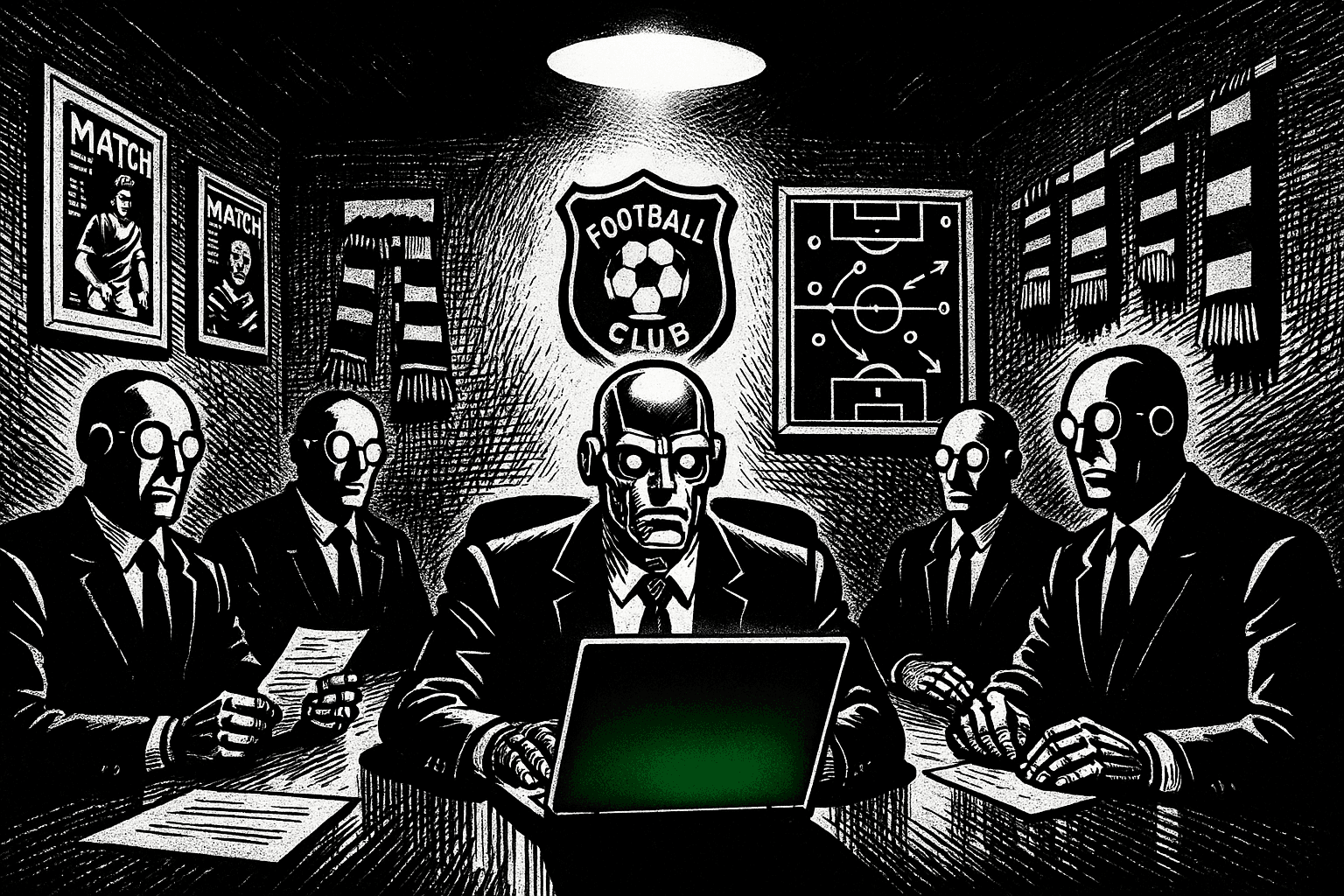

Three phone calls. That was all the president of the United States needed to change the FIFA Disciplinary Code in the middle of a World Cup. Donald Trump picked up the phone, dialled Gianni Infantino's number and obtained what no lawyer or formal appeal would have achieved: the lifting of an automatic suspension for one of his national team's strikers — a ban that had been automatic for decades, because that was the rule.
The player had been sent off after stamping on an opponent's ankle, a foul the referee spotted through VAR. Straight red, one-match suspension, out of the round of sixteen. The most basic disciplinary arithmetic in football. Except that the United States Soccer Federation mounted a lobbying operation backed by the White House, Trump called Infantino three times, branded the referee "very suspicious" on social media and spoke of a "grave injustice". The FIFA Disciplinary Commission pulled Article 27 of its own Code out of thin air and suspended the application of the ban, placing the player on a one-year probationary period. A sent-off footballer who played anyway.
FIFA's corruption has changed in form but not in substance. Before, it was briefcases. Now it is phone calls from presidents. The mechanism has grown more sophisticated, has dressed itself up as diplomacy and marketing, but the result is the same as always. The rule bends for those who hold power.
Set against this episode the scene from May 2011 at the Hyatt Regency Hotel in Port of Spain. The vice-president of the Bahamas Football Association, Fred Lunn, opened a manila envelope and found inside four bundles of crisp hundred-dollar bills. Forty thousand dollars in total. The delegates of the 25 Caribbean federations had been summoned to collect a "campaign gift" from Mohamed bin Hammam, then president of the Asian Football Confederation, who was competing for the FIFA presidency. Lunn photographed the money and returned it. In a hidden recording, Jack Warner admitted to the delegates that he himself had suggested to Bin Hammam giving cash rather than souvenirs, because money was useful for more things. Poetic.
The leap from that envelope to Trump's phone calls is precisely the argument. Ordinary corruption — the physical banknote, the briefcase — was crude, traceable, punishable. Today's operates in plain sight, with the president of a major power pressing in real time for a player and a disciplinary commission that complies by sheltering behind an article of its own regulations. Nobody puts a hand in anyone's pocket. There is no need.
And yet the curious thing is that not even the old corruption, the briefcase kind, ended up where it should have. The FIFA Gate of May 2015 was the biggest judicial earthquake football has ever experienced. The United States Department of Justice, with the FBI and the IRS in tow, indicted 14 officials and marketing executives for wire fraud, racketeering and money laundering.
They applied the RICO Act — the statute designed for organised crime — arguing that FIFA functioned in practical terms as a transnational criminal enterprise. The raid on the Hotel Baur au Lac in Zurich became the defining image of a clean-up that looked definitive.
It was not. Ten years on, the balance sheet is a disaster for anyone who believed that American judicial extraterritoriality would redraw world football. Jack Warner, charged in the United States with receiving ten million dollars from South African officials in exchange for his vote in favour of the 2010 World Cup host, plus 1.6 million from Bin Hammam and 450,000 linked to Qatar 2022, won the battle. The courts of Trinidad and Tobago blocked his extradition. The state's own lawyer, British barrister Robert Strang, was forced to admit in court that the "Authority to Proceed" signed in 2015 was tainted and that the specialty certificate presented to the courts was fictitious. Previous administrations had misled the courts of appeal and even the Privy Council in London. Warner free, case closed.
Where the South African bribe money went is known in forensic accounting detail. According to the DOJ indictment, in 2008 secretary general Jérôme Valcke coordinated the transfer of ten million dollars from the South African Football Association, led by Danny Jordaan, to Warner's accounts at CONCACAF. It was justified as support for the development of football among the African diaspora in the Caribbean. Warner used 1.6 million to pay off personal loans and credit cards, moved 360,000 in cash to his associates and deposited 4.86 million directly into the accounts of a Trinidadian supermarket chain, JTA Supermarkets. A World Cup vote, converted into supermarket aisles. And nobody paid for it in prison.
The list of escapes is long. Sepp Blatter and Michel Platini, indicted in Switzerland over that two-million-Swiss-franc payment of 2011, were acquitted in Bellinzona in 2022 and again in Muttenz in March 2025, when the Court of Appeals applied the in dubio pro reo principle on the grounds that neither intent nor financial harm had been proved. In August 2025 the Swiss prosecution declined to appeal. Ten years of criminal proceedings ending in nothing criminal, though the ethical bans remained in force. Bin Hammam had his lifetime ban annulled by the Court of Arbitration for Sport in July 2012, with the tribunal itself clarifying that the ruling was a "case not proven" rather than a declaration of innocence, and noting that the Qatari had in all likelihood been the source of the money. Marco Polo Del Nero avoided extradition by staying in Brazil, which does not hand over its own nationals. Nasser Al-Khelaifi, indicted in the Valcke case, was acquitted because the Swiss courts concluded that FIFA had suffered no real harm, since the terms negotiated with beIN Media Group were favourable to the federation. They almost did him a favour.
Only a few paid in any meaningful sense. Valcke received eleven months of suspended prison in 2022 for document forgery and passive corruption, a sentence that subsequently became final. Canover Watson, former treasurer of the Cayman Islands football federation, received seven years of actual prison time for the CarePay case. Chuck Blazer, the man who recorded meetings with a microphone hidden in a keyring during the London 2012 Olympics, pleaded guilty to ten counts and died in 2017. Jeffrey Webb, found guilty in 2015 and committed to returning 6.7 million dollars, has postponed his sentencing more than fifteen times in exchange for cooperation, under house arrest so lax in Atlanta that he was allowed out from eight to five to care for his son. Justice as a state of indefinite exception.
The honest objection is worth making. Nothing that the teams who felt wronged have alleged is proven. A team losing after leading does not prove that the referee or VAR worked to keep a star player in the tournament for commercial reasons. A foul not reviewed before a stoppage-time goal, or a disallowed goal, fit perfectly within the human margin of error of any refereeing performance. Just as the anomalies involving Byron Moreno with Italy or Gamal Al-Ghandour with Spain at Korea-Japan 2002 were never proved as conspiracy in any court, despite the suspicions. The perception of fixing is not fixing. And someone who has spent decades seeing ghosts behind every unawarded penalty is not the best witness.
But the case of the suspension lifted by telephone requires no interpretation. There is no suspicion there — there is a case file. The difference between 1978, when Videla sent 35,000 tonnes of wheat and 50 million in credits to Peru around the time of the 6-0 in Rosario without FIFA ever opening an investigation, and today, is that now the favour is done by phone and leaves a record. FIFA no longer needs to hide the briefcase. It just needs to answer the call.