
For decades, supplementation in professional football worked the way almost everything in the dressing room worked: by oral tradition. The fitness coach recommended a generic multivitamin, the kit man handed out identical protein shakes to the 68-kilo full-back and the 92-kilo centre-half, and nobody asked too many questions. That model is dead. Today, before an elite footballer takes a single capsule, he goes through a blood test measuring ferritin, vitamin D, creatine kinase and interleukin-6, among other markers of fatigue and inflammation. The operating principle has been completely inverted: analyse first, supplement second, and if there is no detected deficiency and no specific performance objective, the medical department's answer is not to supplement at all. It is what the literature calls precision nutrition: an approach built on genetic and metabolic tools that replaces the empirical dressing-room recipe with an individualised, reviewable and auditable prescription. And its adoption is not a fashion but a convergence of pressures: scientific, regulatory and, above all, financial. Because when a company's main asset is eleven bodies whose combined value can exceed five hundred million euros, leaving their internal chemistry to custom is, quite simply, bad management.
The regulatory pressure deserves attention because it explains much of the change in behaviour. The World Anti-Doping Agency operates under the principle of strict liability: the player is responsible for whatever shows up in his urine, regardless of how it got there. And supplements, it is worth remembering, are not regulated as medicines, so a product bought legally may contain banned substances not declared on the label. An analysis carried out in the United Kingdom found that up to 75 percent of the pre-workout products and fat burners examined contained banned substances. Faced with that landscape, clubs have standardised a defensive protocol: only products with independent batch certification are allowed — seals such as Informed-Sport or NSF Certified — and evidence of every batch consumed is filed away. As the anti-doping bodies themselves acknowledge, no supplement is one hundred percent safe; zero risk exists only in abstaining, and everything else is documented probability management. The asymmetry of incentives is brutal and worth spelling out: the marginal benefit of a well-chosen supplement is measured in low single-digit percentages, while the cost of a positive test from contamination is measured in months of suspension, in the market value of a stigmatised player and in the reputational damage to a club that failed to control what came into its dressing room. With that risk matrix on the table, the question a medical director asks today is no longer "what can this product add?" but "what can it cost us?".
That same logic of permanent auditing explains the casualty list. The 2000s and 2010s were the golden age of thermogenics and aggressive stimulants: ephedrine, synephrine, DMAA, caffeine doses that would look reckless today. Systematic reviews destroyed the commercial argument by showing that fat burners produce very small reductions in body fat, smaller than what diet and exercise achieve on their own, with a cardiovascular and doping risk profile no medical department is willing to take on. Something similar happened with excess protein. The current consensus puts a footballer's needs at 1.4 to 2.0 grams per kilo per day, with 20 to 40 grams of high-quality protein after exertion; post-match megadoses do not speed up recovery and do overload the body, raising urea levels and encouraging dehydration. The message club nutritionists repeat today is deliberately anti-marketing: eat before you supplement.
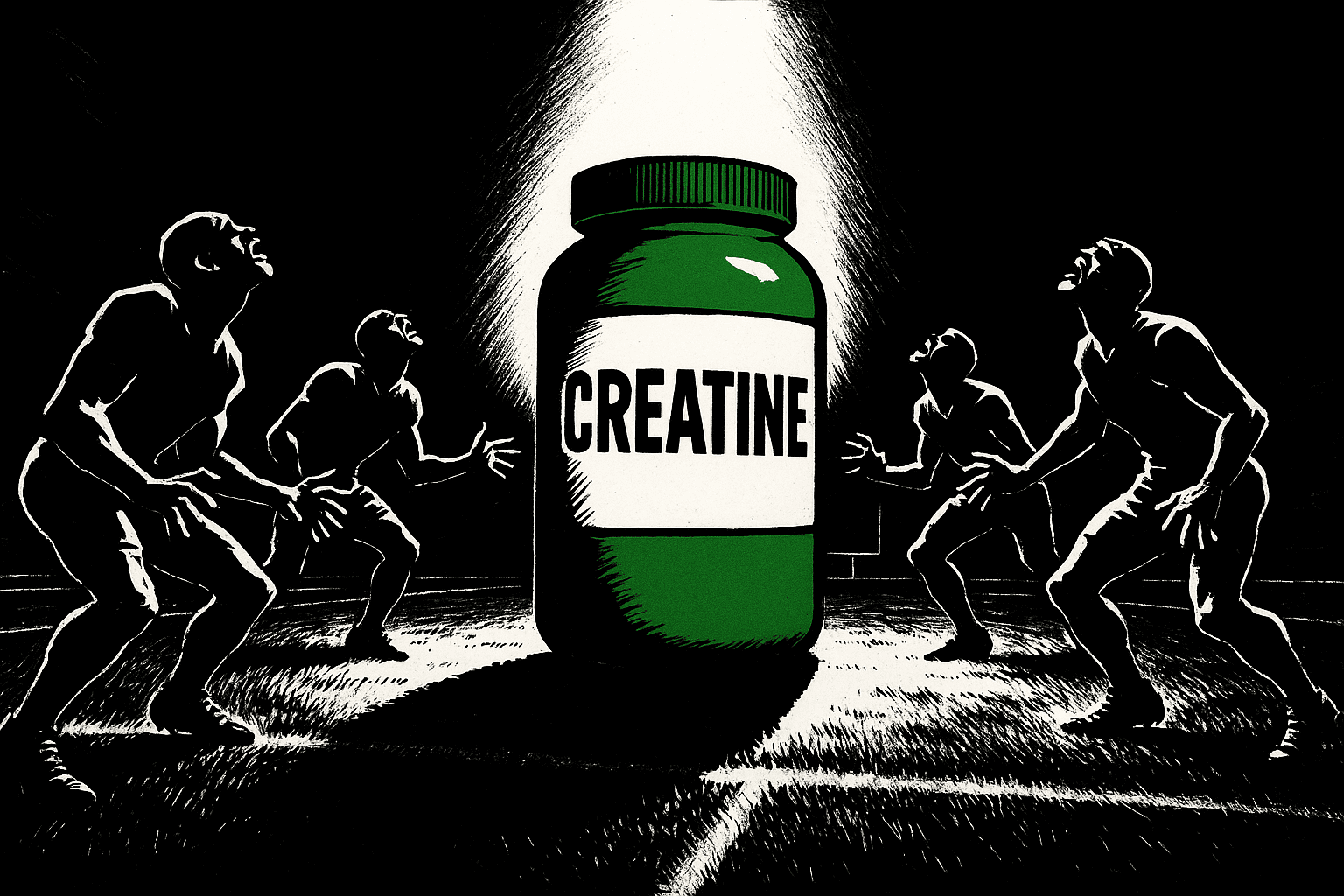
That the list has been pruned, however, does not mean it has been emptied. The two veterans of the catalogue — creatine and omega-3 — are still there, though with protocols unrecognisable next to those of fifteen years ago. Creatine monohydrate remains the supplement with the strongest ergogenic evidence in the history of sports nutrition, but the classic loading phase of 20 to 30 grams a day for a week has been shelved: elite teams prefer moderate, constant doses of 3 to 5 grams a day all year round, a pattern that avoids the initial gain in water weight and improves adherence. FC Barcelona's protocols, to cite a documented case, work with around 5 grams a day on a continuous basis, adjusted to the competitive calendar and even maintained during rest periods: creatine has stopped being a pre-season supplement to become a background physiological constant. The genuinely new part, however, is the reason it is prescribed. A recent meta-analysis covering 16 controlled trials and 492 athletes documented significant improvements in memory and processing speed, effects that are amplified under mental fatigue. Translated to the pitch: in the 85th minute, when neuronal energy depletion degrades decision-making, creatine helps sustain the brain, not just the muscle. That is why some top-level clubs explicitly include "brain support" among the objectives of their supplementation protocol.
Omega-3 has travelled a parallel road. Historically prescribed for cardiovascular health, it is now aimed at modulating post-exercise inflammation: a 2026 review of 41 controlled trials showed moderate reductions in IL-6, TNF-alpha, creatine kinase and muscle soreness with doses of 2 to 3 grams a day of high-purity EPA and DHA, particularly after several weeks of continuous use. With a nuance medical departments handle carefully: inflammation is not only an enemy, it is also the signal that triggers adaptation to training. Silencing it as a matter of course would be counterproductive, so the regimen is combined with periods of strategic recovery to dampen residual inflammation without switching off the adaptive stimulus.
Alongside these reformulated classics, the current cutting edge is occupied by compounds used almost surgically, designed for the structural problem of contemporary football: a calendar that no longer leaves room to recover. With an expanded Club World Cup, swollen continental competitions and international windows embedded mid-season, the elite player strings together stretches of three matches a week for months, and there supplementation stops chasing one-off performance to chase something more prosaic and more valuable: that the footballer arrives intact at the next match. Montmorency tart cherry concentrate, rich in anthocyanins and natural melatonin, speeds up the recovery of maximum strength and jump power after intense efforts, dampens systemic inflammatory markers such as C-reactive protein and, on top of that, improves sleep quality by raising endogenous melatonin levels. A single product that attacks muscle inflammation and night-time rest at the same time is, in squad-management terms, an efficiency that is hard to ignore. Along the same lines, sodium bicarbonate — an ergogenic aid known for decades but abandoned because of its gastrointestinal effects — has returned in enteric-coated capsules: a study with cyclists showed that 0.3 grams per kilo in this format raised blood pH, improved times in a 4-kilometre test by 8 to 9 seconds and almost halved adverse digestive effects compared with the traditional format. For a sport where matches are decided by sprints in the final ten minutes, delaying acidosis without stomach trouble is a marginal advantage that can be measured precisely. And caffeine, an undisputed ergogenic aid at doses of 3 to 6 milligrams per kilo, has resolved its great contradiction — a half-life of 6 to 8 hours that ruined sleep after night matches — through ultra-fast absorption formats: caffeine chewing gum reaches peak concentrations in 45 to 80 minutes against the 84 to 120 of a capsule, which allows it to be given at the start of the second half and cleared before bedtime.
None of the above, however, would on its own explain the growing investment by clubs in their own laboratories and nutritional consultancy. What explains it is the profit and loss account. One study estimated that a typical Premier League team loses around 45 million pounds a year to injuries, of which only 9 correspond to wages paid to inactive players; the remaining 36 are revenues and prize money that evaporate through lost performance. The same literature calculates that every 136 player-days lost cost roughly one point in the table, and UEFA's longitudinal studies consistently confirm that teams with greater squad availability climb positions and reduce muscle and ligament injuries when they follow data-based guidelines. It is no accident that squad availability has become the favourite management indicator of the most sophisticated sporting directors: it is the metric that connects the invisible work of the medical department with the visible result on Sunday. As one medical director quoted in that literature summed it up, the key to keeping players available is preventing injuries, an apparent truism that hides an entire causal chain: correct dosing of creatine, omega-3 or bicarbonate reduces the accumulated fatigue that precedes the muscle strain; better managed sleep reduces the overload that precedes the tear; and every link in that chain is now measurable, traceable and something you can put in a budget.
Under that arithmetic, spending on blood tests, inflammation markers, genetic profiles and nutritional consultancy stops being a whim of the medical department and becomes one of the club's best-returning investments: every injury avoided is an available player, every available player is points, and every point has a perfectly known market price, whether in competition prize money, in television rights tied to final position or in the valuation of the asset itself, because a player with an injury history depreciates the way a machine with a breakdown history depreciates. Precision supplementation is not, in the end, a story about capsules and powders: it is a story about asset management, where the asset runs, jumps, gets tired, sleeps badly after night matches and costs eighty million. The clubs that understand it first will not win leagues by drinking tart cherry juice; they will win them because, week after week, they will have more players in a condition to compete for them.